
The Robotic-SNS project aims to transform rehabilitation in the National Health System (NHS) with the ABLE Exoskeleton: a lightweight, accessible and quick-to-fit robotic exoskeleton. Through artificial intelligence and a multicenter clinical trial, it seeks to improve the independence of patients with spinal cord injury, demonstrating both its efficacy and cost-effectiveness. A pioneering initiative towards a more inclusive and technologically advanced health care.
Current Rehabilitation in the NHS
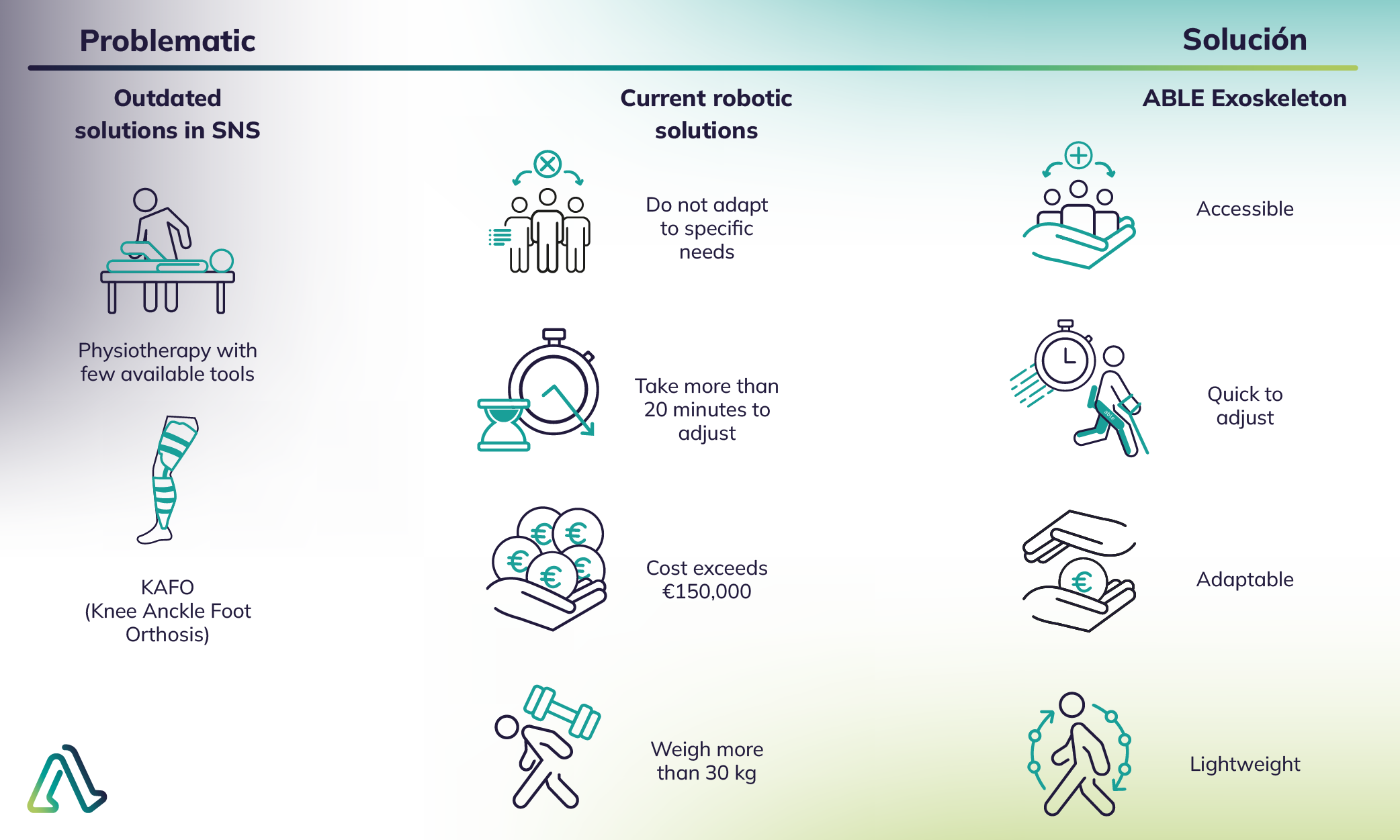
Loss of mobility has a devastating impact on the quality of life of neurological patients, especially those who have suffered a spinal cord injury (SCI). For them, rehabilitation is not only a necessity, but a bridge to greater independence and community reintegration. However, the rehabilitation tools available in the National Health System (NHS) have hardly evolved in the last decades. Equipment such as parallel bars, standing devices and KAFOs, while fulfilling their basic function, do not take advantage of technological advances that could revolutionize the rehabilitation process.
The Current Problem and the Limits of Traditional Rehabilitation
Although robotic-assisted gait training (RAGT) has proven to be more effective than conventional therapies, its adoption has been limited by several factors: current devices cost more than 150,000 euros, weigh more than 30 kg, take more than 20 minutes to adjust from one patient to another, and are not properly adapted to the specific needs of each patient. This reality underscores the need to create more accessible, effective and efficient technologies for the public health system.
ABLE Human Motion solution
Taking into account the main problems of current solutions, ABLE Human Motion was born with the mission to democratize access to robotic exoskeletons. With this in mind, the ABLE Exoskeleton was created, a lightweight, quick-to-fit and accessible exoskeleton for neurorehabilitation.
The objective of the Robotic-SNS project
Robotic-SNS has as technical objectives to improve the capabilities of the ABLE Exoskeleton by:
- Development of bio-inspired adaptive control strategies: These strategies, based on principles of motor recovery and neuroplasticity, will allow the exoskeleton to automatically adjust the level of assistance according to the user’s muscle activity.
- AI-driven software platform: An innovative platform that will analyze data to support clinical decisions and display relevant information for healthcare payers. This will enable the personalization of therapies and show the real value of the technology.
The project will follow a user-centric approach, encouraging co-creation between engineers, clinicians and patients to ensure that the device meets the real needs of the NHS.
Clinical and economic evaluation: A comprehensive approach
One of the most innovative aspects of the project is the Multicenter Clinical Trial to be carried out in 2 public hospitals of reference in the treatment of spinal cord injury: the Vall d’Hebron University Hospital and the National Hospital of Paraplegics in Toledo. This trial will not only measure functional criteria, but also physiological, psychological and economic variables, providing a comprehensive assessment of the impact of the ABLE Exoskeleton in the NHS.
The University of Lleida will lead a cost-effectiveness study, analyzing the use of the exoskeleton versus conventional rehabilitation. The results of this study could revolutionize the healthcare model, demonstrating that exoskeletons not only improve the quality of life of patients but also represent a cost-effective investment for the public health system.
Project Impact: A More Inclusive Future
Robotic-SNS has the potential to mark a before and after in neurological rehabilitation. By combining advanced robotic technology with artificial intelligence and clinical evidence, the project seeks to set a new standard in healthcare. Furthermore, by promoting the local production of exoskeletons, the project will contribute to the economic and technological development of the region.
Ultimately, Robotic-SNS aims not only to improve the quality of life of patients but also to demonstrate that technology-based rehabilitation can and should be accessible to all. This project is a firm step towards a more inclusive, efficient and future-proof healthcare system.

El proyecto “Robotic-SNS”: Desarrollo e Implementación de Rehabilitación Robótica Value-based en el Sistema Nacional de Salud (SNS)”, con número de expediente CPP2023-010742, ha sido financiado por las Ayudas a Proyectos de Colaboración Público-Privada, Convocatoria 2023, del Plan Estatal De Investigación Científica, Técnica y de Innovación 2021-2023 del Ministerio de Ciencia, Innovación y Universidades, y por la Unión Europea – NextGenerationEU.

Contact us if you have any questions on this project!


