
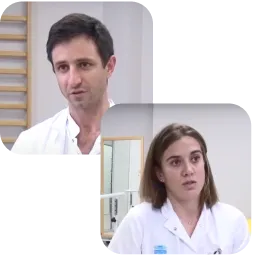
Testimonial by Paula Martos and Laura Poveda from Fundación del Lesionado Medular (Madrid)
We visited Fundación Lesionado Medular to learn about their experience with the ABLE exoskeleton.
Other clinicians testimonials
Prof. José Estay
Mariona Tolrà

Dr. Antonio de Lacy
Mark Wright
Video transcript:
What convinced you after the demo to take the step and adopt the ABLE Exoskeleton in your clinic?
From the demo we saw that it was a device that was very easy to use, intuitive both for the patient and for the therapist, we were convinced by the speed with which it could be put on and adjusted as well as the versatility it offered, being able to be used in very different user profiles. We felt that it was going to integrate very well into our daily routine and that it was going to offer us great dynamism in our rehabilitation sessions.
What clinical problem or need were you looking to solve when acquiring it?
We were looking to re-educate gait in a more intensive and safe way, especially in the early stages of rehabilitation where it is more difficult to perform so many steps, whether due to fatigue, lack of strength or other factors that may influence daily life, in addition we were looking to offer our patients an innovative and different experience, but not only in gait re-education but also all the benefits that standing offers in people with complete spinal cord injuries.
What benefits were you expecting to obtain at a clinical or institutional level?
We were looking to facilitate the participation of users with different levels of injury, in addition to gait re-education, to increase the strength of the preserved musculature, to increase trunk control and body scheme in standing as well as improvements in other body systems such as the circulatory, respiratory or bone system by subjecting the lower joints to load. At an institutional level, we were looking to differentiate ourselves as a center, incorporate cutting-edge technology and offer a more comprehensive service.
How does the exoskeleton influence patient motivation during treatment?
Patient motivation experiences a notable change with the use of the exoskeleton, for many users it is the first time they stand up or manage to walk after the injury, here at the foundation we usually place a mirror in front of them so they can see themselves and this generates a great impact on them. And not only for them but it also creates a very special moment with their environment during the session, in addition being able to gradually objectify their achievements and see the work they do every day is important for them.
Have you noticed any emotional or psychological impact in patients when walking with the device?
Many patients become emotional when standing up again or walking after a long time in some cases, for them confidence, mood, adherence to treatment and participation during it are important, although there are users who have used other types of gait devices, what they highlight about the ABLE exoskeleton is the fluidity with which they walk, in addition it is important for them to be able to walk outdoors again, they care a lot that other users also see them and encourage them as well as being able to do the routes they usually do in a wheelchair walking and in a more fluid and faster way, this motivates and moves them a lot.
What improvements have you observed in patients after using the exoskeleton?
In people with incomplete spinal cord injury we have seen clear improvements in terms of gait pattern, muscle activation and endurance, in addition to improved safety and confidence during walking. And in people with complete spinal cord injury although the objectives are different, benefits are observed in posture, trunk balance, reduction of muscle tone, tolerance to effort and standing as well as what it means to walk again even if assisted.
Share


