
Testimonial by Mark Wright
Mark Wright is a physiotherapist at the Guttmann Institute, working in rehabilitation and research. He shares with us his experience working with the ABLE Exoskeleton.
Other clinicians testimonials

Prof. Dr.-Ing Rüdriger Rupp
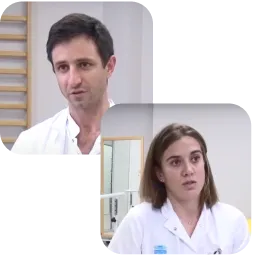
Prof. José Estay
Mariona Tolrà

Dr. Antonio de Lacy
Video transcript: "What do clinical experts say about ABLE Exoskeleton?"
Which challenges do you normally encounter during rehabilitation in the hospital? What kind of pain points do you have?
Rehab, particularly with spinal cord injury, can be difficult at times. One of the main things can be the availability of equipment. Often, as well, it can be quite hard work for the physios.
How do you normally deliver gait training?
It depends, I mean, more traditional methods have been put in the long leg splints so the KAFOs on. If someone’s got enough trunk stability, we put the KAFOs on and the walking frame and maybe with one or two of us, we’re actually helping that patient take steps and move forwards but it can be quite hard work.
What benefits do you see in using exoskeletons?
It’s definitely helpful for the physios; patients in particular very much enjoy it; you can actually get what we say more normal step patterns, for example with the hip and the knee. Often patients can fatigue quite quickly with the other methods. With robotics, we find that actually you can get a lot more repetitions which is very important as we know for anyone who has any potential to recover gait after a spinal cord injury, high repetitions is one of the main things that they need to be doing.
Which health aspects do you think that gait training with an exoskeleton can improve?
On one side, you’ve got those patients who may [have] more incomplete spinal cord injuries. So in that sense, a robotic exoskeleton can help us a lot in terms of getting lots of repetition of gait training, helping to strengthen the muscles, helping the patients to get used to taking steps, and getting that rhythm of walking. So, we’ve seen it, we’ve seen some change with a couple of the patients . Your other side are patients who are more chronic and often are complete spinal cord injuries. With these patients, we wouldn’t necessarily be using it in the idea that they’re going to recover walking outside without using the robotic, but by using the robotic, we can see things like reductions in spasticity. We can help with circulation and bladder and bowel. Bone health is obviously really important, So, the exoskeleton can really help in terms of achieving lots of things at one time. And also, I think as well for the patients to feel good again,
Could you describe your experience using the ABLE Exoskeleton during this clinical trial?
Yeah, I think we had a good experience. We had lots of different types of patients. Our last patient who was, you know, actually doing very well. He was progressing very quickly. But he was a lower level injury. He was improving with the exoskeleton. He actually improved more and more and more. But then with our other guys the sort of these more severe injuries, I think the great thing about the ABLE is you’ve got that adaptability. We can change the amount of assistance in the motors for example.
What was your biggest learning?
My biggest learning probably would be to trust to trust the patients a bit more with how much stability they had. I think just purely from my own (whatever) mentality, I was holding on to and giving them more support than they needed. I think sometimes I was even pulling them back uh slightly. So yeah, that’s one thing, I think certainly the amount of support that the exoskeleton gives and the patient executive
Which is the thing that you like the most about the device?
I like a few things actually. Ǫuick to understand, it takes no more than a session or two to really get a handle on. I think it’s a good level where okay there’s things that can be changed like parameters this length of Step Etc… that could be changed but it’s not too much it’s not too overwhelming. I think the other thing is the speed at which you can get it on and off, it is light as well. Turning assistance I like the turning assistance that’s a good feature.
Any highlights from the patients, what do they say?
Lots of them reported how stable they felt. They actually felt they could do lots, lots more repetitions. Some of them were already doing Lokomat training. Some of them were already doing the KAFO training. They were saying “I can maybe do 10 – 15 minutes with the other one, with the EXO I can do half an hour”. So I think that ability to go further, do more.
Did you notice any relevant clinical improvement with the patients?
The more chronic ones we saw a reduction in spasticity. One of our guys like I say went from quite heavily assisted walking with a frame to then using crutches by the end of the training. He was using crutches with just distant supervision
What would you improve for future versions of the device?
What would be great to see is the ability to then how we do side steps and backward steps You need to have that adaptability in in the environment so being able to go in whatever you want to call it 360 Degrees if that makes sense directionally
Is there a need for a home or outdoors exoskeleton?
So, [people with] chronic spinal cord injuries they do need standing programs, so they should be standing, if not every day, at least three times a week. If you had an exoskeleton that could do that and do cardiovascular training, then definitely. [Using it] outside in the community, I think that step is something that would be amazing. You know, someone can put the exoskeleton on and then they’re out, you know, out for a couple of hours walking, or whatever, with friends and family… if you could get to that point, that would be incredible.
What role do you think that clinicians should take in the development of these new technologies?
It’s a bit arrogant to say isn’t it but no I think it’s important. If we’re thinking about an exoskeleton that can be used in the community and beyond. We need to be thinking about where do patients get to in five years, ten years etc. what’s their daily life look like to actually produce an exoskeleton that provides more benefits and a better quality of life for them.
Three words describing the ABLE Exoskeleton.
Simple light and efficient
Share


