
Testimonial by Prof. dr. Noël L.W. Keiksers and Eline Zwijgers
Noël Keijsers is senior researcher at the Sint Maartenskliniek and professor of clinical motor control at Radboud University. Eline Zwijgers works as a researcher at the Sint Maartenskliniek Hospital.
Both share their experience working with the ABLE Exoskeleton:
Other clinicians testimonials
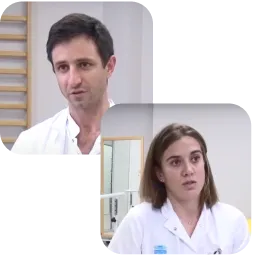
Prof. José Estay
Mariona Tolrà

Dr. Antonio de Lacy
Mark Wright
Transcript of the video ‘What do clinical experts say about the ABLE exoskeleton? Sint Maartenskliniek Hospital’.
My name is Noël Keijsers. I’m a senior researcher at Sint Maartenskliniek and a professor in clinical motor control at Radboud University. My main focus of my research is improving the gait capacity of patients with neurological disorders such as stroke or spinal cord injury.
Which challenges do you normally encounter during gait rehabilitation in the hospital? Pain points?
One of the most important pain points is training intensity. So what we actually suggest is that you train as much as possible, making as many steps within a training session.
And that becomes very difficult if you don’t have the capacity to walk. For these kinds of patients, you can use, for example, exoskeletons or body weight support systems. By introducing those body weight support systems or exoskeletons, you can improve the number of steps they can take and also improve the number of training sessions during a day.
What benefits do you see in using exoskeletons? (for the patient and for the physiotherapist). How can it help to tackle the previous pain points?
Exoskeletons can really help the patients when they don’t have the ability or capacity to walk by themselves. So they need kind of assistance. And if you do that with a physiotherapist itself, then the physiotherapist has to carry the patient. The exoskeleton will carry the patient and also guide the movements of the patient when walking. So both physiotherapists and patients will benefit from it. And the physiotherapists don’t need to use his hands, so he can also give feedback to the patients on how to perform better or improve their walking capacity.
My name is Eline Zwijgers and for the past three years I’ve been working as a researcher at the Sint Maartenskliniek Hospital in the Netherlands.
Can you briefly describe the trial that you performed with the ABLE Exoskeleton? What did you want to learn? Why was this an important area to study?
Over the past eight years, the Sint Maartenskliniek gained experience with training people with complete spinal cord injury using commercially available exoskeletons, especially the ReWalk exoskeleton, both in a clinical setting but also in their home environments. But what we noticed during these studies, but also during the training sessions, is that people with complete spinal cord injuries sometimes face challenges with controlling the exoskeleton. And this is mainly because they miss important sensory information from below their lesion level. And what this means is that they miss information from their legs, saying on what leg they are standing or what leg is in front of the other one. So we thought maybe we can give this information, this missing information, another way, by another sensory system. We call this sensory substitution.
So we thought, let’s study that. And then in July 2022, we came in contact with ABLE Human Motion, and they mentioned that they were developing a sensory feedback system within their exoskeleton. So we decided to partner up with ABLE and work with their exoskeleton to perform the study on the effect of sensory feedback on exoskeleton use.
What was something interesting that you learned during the trial?
Yeah, so all the participants that participated in the study have previous experience with walking in the ReWalk exoskeleton. But this was already four to six years ago. So we thought the participants needed some time to adjust to the Able exoskeleton and they needed some time to learn how to walk in this new exoskeleton. But what was very surprising to us was that the participants really quickly adapted to the ABLE Exoskeleton. And by the end of the first session, all participants knew how to walk in the exoskeleton and could make at least a few steps in this exo.
What do you like the most about the device?
Yeah, so what I like most about the Able exoskeleton is how quickly you can adjust the sizes to the user. For the ReWalk exoskeleton, it took us about 15 to 30 minutes to adjust the exoskeleton to the user. But for the Able exoskeleton, it only took us five minutes to adjust it, and then we were ready to go and start with the training. And also the donning and doffing was very fast, so in five minutes we had the participants inside the exoskeleton, and we were ready to stand up, which really left us with a lot of time for the actual training in the exoskeleton. And from a user perspective, what I really liked about the exoskeleton is that the user is really in control of the exoskeleton. So the user decides when to make a step and when to pause. And because of this, the user is really more like a pilot of the exoskeleton instead of a passenger of a robotic device.
What would you improve for future versions of the device?
Yeah, so the Able exoskeleton is originally designed for the Spanish population, and they have a max height limit of 190 centimeters. And the Dutch population is quite tall, So my suggestion would be to make the exoskeleton suitable for a taller population, so all Dutch patients can walk in the Able exoskeleton.
Where do you see the future of exoskeletons for rehabilitation going?
Within the hospital, I would expect that such an exoskeleton would be really easy to put on, for example, like you do with your trousers, and you can start immediately with your training. So even a physiotherapist is not needed to put it on. For me, the main goal would be using such an exoskeleton in the home situation. And what I envision is that in the near future, we will have a lightweight exoskeleton that you can wear within a wheelchair and just raise up and stand without using other devices like crutches.
Why is it important to have exoskeletons available for home or personal use? What are the 3 most important things we should consider when designing them?
First most important thing to design an exoskeleton for Home and Community use is the easiness of use. Putting it on within a couple of seconds but I mean within a minute will be very very important. The other thing would be that it is lightweight so that they can handle the product without any effort. So if it would be 50 kilograms and you have to carry it from one place to another that will be very hard if you sit in a wheelchair. Third point is also that you can use it for example when you sit in a wheelchair so sitting in a wheelchair you raise up and you can stand with the exoskeleton will be also beneficial.
Three words describing the ABLE Exoskeleton.
If I had to describe the exoskeleton in just three words, I would say it is a lightweight system. It is also intuitive and user-friendly for both participants and clinicians. These three words effectively describe the exo.
Share


