
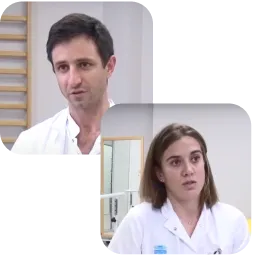
Testimonial by Almudena Chao and Adrian Vegue from the Multiple Sclerosis Foundation of Madrid (Fundación de Esclerosis Múltiple de Madrid, FEMM)
Almudena Chao is a physiotherapist and physiotherapy coordinator at the Multiple Sclerosis Foundation of Madrid. She is also the principal investigator of the ABLE exoskeleton study. Adrián Vegue is a physiotherapist at the Multiple Sclerosis Foundation of Madrid. Both tell us about their experience working with the ABLE Exoskeleton:
Other clinicians testimonials
Prof. José Estay
Mariona Tolrà

Dr. Antonio de Lacy
Mark Wright
Video transcript: "What do clinical experts say about ABLE Exoskeleton?"
Testimonial Almudena Chao:
In general, what are the main challenges in the rehabilitation of patients with multiple sclerosis?
Stop the progress of the disease, since it is degenerative. Well, it is always a bit of a fight against time, and well, we do see that in many cases, apart from being able to stop this evolution, improvements and advances are achieved in the condition of the patients.
How can robotics help your rehabilitation? What are the main benefits for the patient? And for the therapist?
Robotics helps us a lot in rehabilitation because it is a very useful tool to get the patient’s maximum potential, since there are times when with conventional therapy and manual therapy there are limits that we cannot overcome in terms of both time and effort.
Tell us about your experience with the ABLE Exoskeleton during the clinical trial that was carried out at FEMM
With the ABLE exoskeleton we are realizing that patients with multiple sclerosis have different symptoms and a different way of acting with respect to the exoskeleton. It responds very well, but it also has a series of limitations that perhaps we do not encounter with other pathologies.
Testimonial Adrian Vegue:
What things did you like most about the exoskeleton?
What we liked most about ABLE is the lightness of the device; Being able to handle it during assembly and disassembly with patients with special difficulty when moving is something quite positive for its handling.
When it comes to placing the particular measurements of each of the participants in the study, it has also been quite agile to use a system of clicks and not have to use as many Velcros. It makes it quite fast. When assembling and disassembling it and then also. We found the turning system to be quite interesting. The fact that it supports the therapist when he makes the shift with the patient. The software device itself that uses it makes the interface very intuitive and very visual, with points where we can see the displacement of the weight within each of the steps. Well, the fact of also being able to limit the percentages of help and have the patient reach their limits and be inside a device that is independent of the device that can be attached through a magnet also facilitates the interaction that the therapist may have with the patient.
Have you observed any physical or psychological improvement in patients who have used it?
The fact of being able to work on an aspect as important as gait in an automated way with a system that gives you feedback like ABLE is quite positive. And they also notice it, that is, they have been able to apply all that knowledge or all those sensations that they gain from the repetition of the steps to their daily lives, which is quite important. Furthermore, for all those patients who precisely cannot stand on their own or who have great difficulty standing for long periods of time, the fact of seeing yourself standing and doing dynamic exercise such as walking, which is only very functional for these people, well, of course, emotionally, also has a truly positive impact.
Other conclusions from the study?
Well, we have learned that there are certain added difficulties in the management of the patient with multiple sclerosis in generating robotic systems due to having a varied set of symptoms that may not be focused. Exactly, only in one, but you may have a patient who has balance difficulties, but at the same time also a hemiplegic pattern and at the same
time also a pattern with certain cognitive impairment. That the exo looks more like, that is, the exoskeleton looks more challenged within each one, and that has made us gradually improve its characteristics and the development of both hardware and software.
Is there any other point you want to highlight?
As for the positive aspects, it is true that it is a system that has quite intelligent solutions regarding assembly and disassembly, which makes it quite agile, and then also the fact that, for example, for patient access, it has its own transfer mode. The fact that I raise the leg makes it easier to introduce the patient to the device, as it also seems very interesting to us. We find the interface and the software it uses quite intuitive, which other devices generally do not have.
3 words about the ABLE Exoskeleton
The opportunity, both for us as professionals and for patients, to use it. A hope above all for patients. There are many patients who, in their normal lives, cannot stand up, or walk, and thanks to the exoskeleton, they are able to do so. And then work, a lot of work of all kinds; For both physiotherapists, it is an extra job, but a job in which you manage to learn a lot, draw many conclusions, and it makes your work better for the patients because it is an extra effort that they do not have in their daily lives and that makes them improve. . And above all, have as a goal, a stimulus, that if you make four steps today, tomorrow six, the next day eight, So there´s that reward later at the end of the session…
Share


