
Testimonial Prof. José Estay & Mariona Tolrà
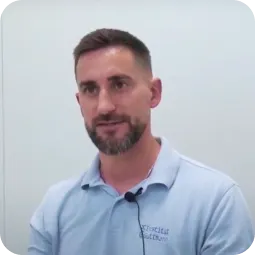
Dr. José Estay as a rehabilitation doctor and Mariona Torlà as a physiotherapist, both working at Asepeyo, tell us about their experience working with the ABLE Exoskeleton.
Other clinicians testimonials

Prof. Dr.-Ing Rüdriger Rupp

Prof. Antonio de Lacy
Mark Wright
Video transcript: "What do clinical experts say about ABLE Exoskeleton?"
Which are the most common health problems after a spinal cord injury?
Especially urinary complications, which have been historically the main complication and leading cause of death and mortality for patients with spinal cord injury. But we also have complications derived from the neurogenic intestine, pressure ulcers, and deep vein thrombosis. Everything related to musculoskeletal injuries, injuries due to overuse of the upper extremities, heterotopic ossifications, and pathological fractures.
What problems do you encounter during gait rehabilitation? How would an exoskeleton help?
One of the main problems is when we transfer from sitting to standing, patients feel very insecure because there are really no devices that help us make that transfer. The exoskeleton would help to support the patient safely with this transfer. And for the therapist, it would help us to reduce the extra effort that we have to make to be able to support the patient safely.
What evidence exists on the use of exoskeletons?
What these studies have shown is that exoskeletons are safe to restore movement functions and that they also have high usability for patients. The use of exoskeletons improves spasticity, improves the quality of life, but by improving the mobility of patients, it also potentially improves their participation in community activities and also their satisfaction and quality of life.
How it has been your experience with the ABLE Exoskeleton during the clinical trial carried out in Asepeyo?
It has been a learning experience both for me and the patients. There have been 10 sessions with five patients, and in the 2 initial sessions we have teached patients how to use the exoskeleton, so they become familiar and perceive their body with the device.
That is to say that they become aware of how far their limit is, what they can do and what the exoskeleton can offer them. For me, I have learned how much assistance I should give to patients. Depending on the injury level of the patient I should assist them more or less. And throughout the study, the support provided by me has decreased, so patients have become more aware of which is the amount of effort and ability required to move the exoskeleton. Also, at an emotional and psychological level, they have realized that by standing they have been able to do a bunch of new activities and I think it has been thanks to the fact that this device is much safer for both the patient and for me.
What differences have you noticed in the exoskeleton compared to the previous version?
One of the most notable differences, I think, would be the turning assistant. Another aspect that I would highlight is having motors at the hip joints. This favours patients’ stability and assists them in walking, so the level of fatigue is lower. It allows me to be in control of the patient at all times and the feeling is not that a robot is in control of the patient, it makes me much more involved in gait re-education.
What information about the gait would you like to get from the exoskeleton?
Well, I think that the information on the different parameters of gait, cadence, number of steps, and such is adequate. An important aspect that we have discussed with the team is that the exoskeleton, in addition to being able to restore gait, is a good tool for patients
with spinal cord injury to do physical activity. So if you have a gait parameter, it would also be interesting to measure the heart rate of the patients during the sessions with the exoskeleton, because it could be a valuable tool for motivation and provide the patient with feedback on which is the impact that the use of the exoskeleton has within different cardiorespiratory and health parameters.
Is there anything the exoskeleton currently can’t do that you wish it could?
Implementing some type of feedback on how the patient is managing their balance or their center of gravity within the limits of stability of the exoskeleton. It could be used to know when you are exceeding these limits, mediolaterally, or anteroposteriorly, and stay within a stability limit, so that in the end you have to depend as little as possible on the use of the crutches or the walker.
I would like that, once we have already re-educated gait, the exoskeleton was capable of going up and down slopes and climbing stairs.
Would you like to use the ABLE Exoskeleton during regular clinical practice at the hospital?
Yes, I would like to, it seems a good device not only to re-educate gait but as a complementary tool for upper extremity rehabilitation. In an indirect way, I think that we can work with gait and upper extremity, with the patient holding the walker. I think they can also be more aware of their own body because when taking the step, if it doesn’t activate equally, the weight is going to lean more to one of the two sides. In other words, I believe that the feedback is much greater with this device and at the same time it allows me to activate a series of muscles that if we worked on it analytically would not be so beneficial for the patient.
How do you see the future of rehabilitation? What role will robotics play?
Well, I believe that robotics has already a very important role in rehabilitation. What is interesting about robotics is that, by using different mechanisms, whether exoskeletons, prosthetic hands, prosthetic knees, or whatever, it is possible to restore these different functions and body structures that have been lost. As technologies develop, improve their ability or improve the ability for patients to control these various robotic terminals, whether it’s with surface electromyography, brain interface, or things that perhaps haven’t been invented yet. As the executive capacity of the different robots improves, we are going to see a much closer integration between the biological functions and the functions that the robot can do.
3 words that come to mind when you think about the ABLE Exoskeleton
Confidence, progress, and overcoming. Movement, accessibility, and innovation.
Share


